Sunday, August 16, 2026
How Much Meat does a Muskellunge eat in a Year compared to River Otter?
Wednesday, August 12, 2026
Friday, June 12, 2026
Otters in Indiana and River Fish Impact - Angler Anecdote vs. Naysayers
To put a finger on the core governance failure, not a scientific flaw:
management decisions are being asked in a data vacuum, and the only long‑term observers are anglers. Ignoring that reality is not only unscientific—it’s how conflicts harden.
Below is a scientifically defensible way to handle angler observations when formal fish counts are absent, without pretending observations are the same as population estimates.
1. Anglers Are Not “Anecdotes” — They Are Unstructured Observers
It is incorrect (and counterproductive) to dismiss angler observations as mere anecdotes.
Anglers:
- Observe the same reaches repeatedly, often for decades
- Fish during biologically critical periods (low flow, spawning, winter)
- Detect changes in encounter rates, size distributions, and behavior
- Notice predators at the exact locations fish decline is perceived
From a scientific standpoint, this makes anglers:
Long‑term, spatially fixed, high‑effort observers with recall bias but strong trend sensitivity
That is not useless data—it is uncalibrated data.
2. What Anglers Are Actually Reporting (and What They Aren’t)
When anglers say:
“The bass are gone since otters showed up”
They are not claiming:
- A census of fish
- A quantified mortality rate
- A mechanistic model of predation
They are reporting:
- Fewer strikes at historically productive sites
- Loss of repeatable patterns (e.g., “that pool always held fish”)
- Increased predator presence coinciding with reduced catch success
This is trend perception, not population estimation.
Science should treat this as:
a hypothesis generator, not a conclusion.
3. Why the “No Counting of Fish” Argument Cuts Both Ways
Pointing out the paradox:
If there is no counting of fish, then science also lacks the data needed to dismiss angler claims.
This means:
- Scientists cannot prove otters are causing declines
- But they also cannot prove otters are harmless at local scales
In data‑poor systems, the correct scientific stance is:
uncertainty acknowledgment, not assumption of no effect.
Failure to admit this is where agencies lose credibility.
4. Reconciling Angler Observations With Ecological Reality
Anglers may be observing localized, short‑term, or conditional impacts
That does not imply basin‑wide or population‑level regulation
Both can be true simultaneously.
Examples:
- Otters repeatedly using a single pool → temporary local depletion
- Fish recolonize later → no long‑term population effect
- Angler loses a reliable hotspot → perceived collapse
This is scale mismatch, not false observation.
5. Why Science Often Misses What Anglers See
Formal monitoring often:
- Occurs once per year or less
- Misses extreme low‑flow or winter bottlenecks
- Averages results across reaches
- Focuses on presence, not vulnerability
Anglers, meanwhile:
- Fish during hard times, not always optimal conditions
- Detect failure of resilience, not absolute abundance
- Notice when predators repeatedly exploit bottlenecks
So anglers are sometimes seeing:
Ecological pinch points, not long‑term trends.
Science rarely measures those without targeted effort.
6. A Scientifically Honest Position Agencies Should Take
Here is the position that respects both science and angler experience:
Angler observations indicate perceived localized declines coincident with increased otter activity. While existing data are insufficient to determine whether these effects reflect population‑level impacts or short‑term redistribution, the observations are consistent with known predator behavior in constrained habitats and merit targeted monitoring rather than dismissal.
This acknowledges:
- Anglers are seeing something real
- Science lacks resolution
- The hypothesis remains open
7. Practical Ways to Use Angler Observations Scientifically
Without “counting all the fish,” agencies could:
A. Pattern convergence
If multiple anglers independently report:
- Same reaches
- Same time periods
- Same size classes missing
That is signal amplification, not anecdote.
B. Sentinel site logic (Overwatch on key pools where otter are present)
Repeated angler attention identifies:
- Recruitment bottlenecks
- Overwintering pools
- Drought refuge
These are exactly where predation could matter most.
C. Structured perception tracking
Even simple:
- “Better / same / worse than last year”
- Size‑class observations
…collected repeatedly is trend data, not guesswork.
8. The Core Truth
In the absence of systematic fish counts, angler observations are not inferior to science—they are the only continuous data stream available, and the scientific failure lies in not calibrating them rather than dismissing them.
A strong, honest, and defensible position?
Bottom Line
- Anglers are not wrong to trust their experience
- Scientists are right to be cautious about causation
- Management fails when it pretends uncertainty means “no effect”
- Otter conflict is fundamentally a data‑scale mismatch problem
Thursday, April 9, 2026
Reaction Summary: River Otter Silent Collapse of Fisheries
Reaction Summary: River Otter Impacts on Fisheries
River Otters and the Silent Collapse of Indiana's Stream Fish Populations
(Anonymized from all direct responses to author)
Across all responses, the article was consistently described as well written, compelling, and validating of what many anglers, trappers, and observers have been experiencing firsthand for years.
Even readers who initially approached the article skeptically often moved toward agreement as they reflected on personal observations. A repeated sentiment was relief at seeing long‑standing concerns articulated clearly, combined with frustration that those concerns have not been meaningfully addressed at an institutional level.
A strong and recurring theme across responses was broad agreement that river otters are exerting substantial predation pressure on fish populations, particularly in small to medium river systems.
Key points of agreement:
- Otter impacts are observable, not theoretical
- Declines have occurred rapidly following otter arrival
- Impacts are not confined to one watershed or state
- Losses extend beyond smallmouth bass to include rough fish, forage fish, catfish, and crayfish
- Several responses explicitly stated agreement with the article’s mathematical and analytical framework, acknowledging uncertainty while still agreeing that consumption levels easily exceed sustainable biomass in many systems.
Across dozens of independent responses, a remarkably consistent sequence was described:
- Otter sign appears (scat, scales, tracks, feeding remains)
- Large fish and rough fish disappear first
- Trophy‑size fish vanish
- Catch rates drop sharply
- Fish remain only in small pockets or migrate out
- Recovery does not occur within years
This pattern was reported in:
- Clear rivers
- Stained rivers (often unnoticed at first)
- Small streams
- Large rivers
- Ponds and small lakes
- In confined systems (ponds, creeks, wintering holes),
depletion was often described as complete and rapid, sometimes occurring within days to weeks.
Many responses emphasized the importance of water visibility.
In clear‑water systems, anglers with decades of experience could:
- Visually inventory fish populations year after year
- Detect abrupt absences with confidence
- Correlate these absences with otter sign
- Multiple participants noted that in stained or turbid waters, the same collapses likely occur but go unrecognized, being dismissed as “bad fishing.”
While most respondents agreed otters are having severe impacts, many took care to emphasize that otters do not act in isolation.
Other stressors frequently cited:
- Sediment and nutrient pollution
- Habitat loss and channel simplification
- Dams and flow alteration
- Invasive species
- Heavy recreational fishing pressure
- Poor fish handling and harvest
- Illegal netting in some areas
- Development encroachment on nursery creeks
A notable portion of respondents made a clear distinction between:
Opposing otters as a species (which most rejected), and Advocating for density‑ and location‑based management (which many supported)
Several expressed discomfort with predator removal solely for recreational fishing benefit, instead favoring:
- Habitat restoration
- Fish handling education
- Sustainable stocking
- Ecosystem‑level management
At the same time, others argued that failure to manage predators also represents an unethical choice, given observable ecosystem collapse. Despite differing philosophies, nearly all agreed that doing nothing is not a neutral option.
A repeated and emotionally charged theme was the perception that state wildlife agencies are slow or unwilling to act. Common concerns included:
- Reactive rather than proactive management
- Lack of targeted studies despite field evidence
- Difficulty engaging agencies in collaborative research
- Regulatory structures that discourage harvest participation
- Bag limits and reporting requirements described as misaligned with current realities
- Several respondents stated that by the time formal studies confirm impact, protection opportunities will already be lost, leaving only long‑term restoration.
Numerous responses pointed out that:
- Active trappers are declining in number
- Per‑trapper harvest limits are very low in some states 2 in Indiana. 10 Per day in Kentucky.
- Administrative burden discourages otter harvest (check traps each day) (take carcass to check in station within 24 hours)
- Quotas may be reached yet impacts still expand
Experiences from private ponds and lakes repeatedly showed:
- Systems going decades without fish removal
- Otter arrival followed by rapid, total depletion Landowners forced into reactive management
Several responses noted fish increasingly migrating into:
- Lakes and reservoirs
However, this also means:
- Many smaller streams no longer support winter fisheries
- Nursery systems are failing
- Angler access and opportunity are shrinking
- Multiple responses estimated that only 10–25% of previously fishable water remains consistently productive.
Despite frustration, many respondents proposed constructive paths forward:
- Systematic documentation with photos and GPS
- Scat collection for DNA or isotope analysis Graduate‑level thesis projects
- Cooperative university partnerships
- Use of historical shocking and netting data where available
Across all reactions, a clear emotional progression emerged:
- Initial curiosity or skepticism
- Recognition through personal observation
- Frustration at repeated confirmation
- Alarm as impacts spread to personal waters
- Resignation or grief over lost fisheries
- Desire to warn others before the pattern repeats
- Many expressed that what was once unthinkable now feels unavoidable
Taken together, all responses form a coherent narrative:
- The article aligns strongly with widespread field observation
- Otter impacts are being detected across systems, states, and habitat types
- Clear‑water rivers are showing the earliest and clearest signals
- Predation pressure is interacting with already‑degraded ecosystems
- Regulatory response is widely perceived as lagging behind reality
- Awareness is spreading laterally among anglers rather than from agencies
- Without early engagement, many fisheries will transition from protectable to restoration‑only
![]() |
| Otters that aren't hungry will often kill for fun and bite out the 'nutritional parts' |
![]() |
| Smallmouth bass head left uneaten, found after winter thaw in Otter toilet |
![]() |
| Otters can digest a fish in less than an hour! |
Tuesday, March 24, 2026
River Otters and the Silent Collapse of Indiana’s Stream Fish Populations
While state agencies continue to promote reintroduction as an unquestioned win, anglers and biologists in neighboring states have long documented serious problems. Missouri’s Department of Conservation chronicled these issues vividly in The Missouri River Otter Saga (2007) and Controversy in Times of Plenty (1999), outlining how unchecked otter populations hammered fish biomass and forced the state to expand trapping seasons and unlimited quotas. Indiana now appears to be following the same trajectory — but without the monitoring infrastructure to even measure the decline.
This article examines why Indiana’s rivers and creeks are uniquely vulnerable, what biologists may have misjudged during reintroduction, and why catchable fish populations may be far more fragile than previously understood.
1. Underestimating Otter Consumption vs. Available Stream Biomass
One of the foundational problems in the Midwest otter‑reintroduction movement was the assumption that rivers and creeks held enough biomass to support breeding otter populations AND Public recreational fishing.
In reality:
• River otters consume around 25% of their body weight per day.
• Small and midsized Indiana rivers and creeks simply do not hold the prey biomass that coastal systems do.
• Prior to reintroduction, no baseline biomass surveys were conducted on most Indiana rivers and creeks.
This means wildlife managers past introduced a high‑metabolism apex predator into systems whose consumption capacity was never properly evaluated. Missouri biologists encountered this exact problem: models radically underestimated fish consumption, otter reproduction rate, otter mortality rate leading to widespread fishery damage before management action was taken.
2. Winter Fish Concentration Makes Predation Devastating
Cold‑blooded species like smallmouth bass, suckers, catfish, rock bass drastically slow down in winter. They cluster tightly in deeper wintering holes — sometimes thousands of fish in a single pool.
Otters, however:
• Swim 6–8 mph even in near‑freezing water
• Hunt continuously
• Prefer large, slow, energy‑rich prey digesting their food at a stunning rate
This creates a catastrophic mismatch:
• Adult broodstock are picked off first because they cannot escape
• Smaller fish survive only by hiding in rock crevices and woody debris
• Otters can wipe out multiple year‑classes in a single winter
• It can take 8-10 years for a smallmouth bass to reach 18”. Decade to replace eaten fish
A single family of otters can empty an entire wintering hole in a couple of weeks.
3. No Pre‑Reintroduction Data Means Declines Cannot Be Quantified
This is one of the most important — and often unspoken — policy failures. Before Indiana reintroduced otters:
• No standardized biomass estimates exist for most rivers and creeks
• No electrofishing historical datasets exist
• Very few rivers have long‑term monitoring
• Nursery‑quality tributaries were never mapped or tracked. Because of this, agencies can continue to say: “There is no data showing otters reduced fish populations.” But the reason they can say that is because no baseline data existed to compare against. Missouri saw the exact same dynamic: by the time declines were undeniable, the damage had already occurred.
4. Otters Are Nocturnal, Hyperactive Apex Predators — Not Plush Toys
Most Hoosiers never see otters. That invisibility fuels public misconceptions:
• People think otters are rare the IDNR recently estimated 8800 river otters in Indiana.
• People assume otters are “cute” and harmless
• People believe otters are “self‑regulating”
In reality:
• Otters are strictly nocturnal or sometimes crepuscular (dusk/dawn)
• Otters are high‑energy predators that hunt nonstop
• Otters have no natural predators in Indiana
• Otters reproduce quickly and expand territory aggressively. They are an apex predator occupying rivers and creeks with no biological controls.
5. Agencies Lack Resources to Monitor Declines or Act on Them
Indiana’s fish & wildlife divisions are:
• chronically underfunded
• understaffed
• lacking river and creek monitoring programs.
Even if they recognized the problem, they face two impossible hurdles:
1. They cannot quantify a decline without baseline data
2. They cannot justify increased trapping limits without quantification.
This political and scientific trap prevents action until fishery collapses reach crisis levels — exactly what Missouri documented decades ago.
6. Biological Assumptions & Mathematical Basis for Predation Pressure
Although precise biomass data may not exist for many Indiana rivers and creeks, several well‑supported biological inputs can model the scale of predation occurring today.
Average Otter Consumption per Year
• 16‑lb average otter
• Eats 25% of body weight per day → 4 lbs/day Fish Portion of Diet
• 50% fish, including majority crawfish in warm months → 2 lbs of fish per day
Annual Consumption
• 2 lbs/day × 365 = 730 lbs of fish per otter per year
Indiana Otter Population Estimate
• Approx. 8,800 otters
Total Annual Fish Consumed
• 730 lbs × 8,800 = 6,424,000 lbs of fish per year
Smallmouth Bass Share
• If smallmouth/largemouth bass represent 10–12% of fish biomass:
1. 6.42M × 10% = 642,400 lbs
2. 6.42M × 12% = 770,880 lbs
Estimated smallmouth consumption: 640,000–770,000 lbs per year.
These values illustrate why predation pressure alone can exceed the consumption capacity of many Indiana rivers and creeks.
Conclusion: Indiana Is Repeating Missouri’s Otter Mistakes.
The warning signs are all present:
• Disappearing adult smallmouth and other large fish species like carp and catfish
• Wiped‑out wintering holes
• Declines where otters colonize
• No biomass monitoring
Indiana urgently needs:
• Intensive biomass studies
• Otter population assessments
• Increased trapping quotas and especially bag limits
• Look into stocking fish, even if privately funded
• Protection of nursery tributaries
Without acknowledging predation pressure, Indiana’s best rivers, creeks, ponds, and lakes may lose their defining species long before the data ever catches up.
What waterways lie in the least trapped counties? Marion county?
Sunday, November 23, 2008
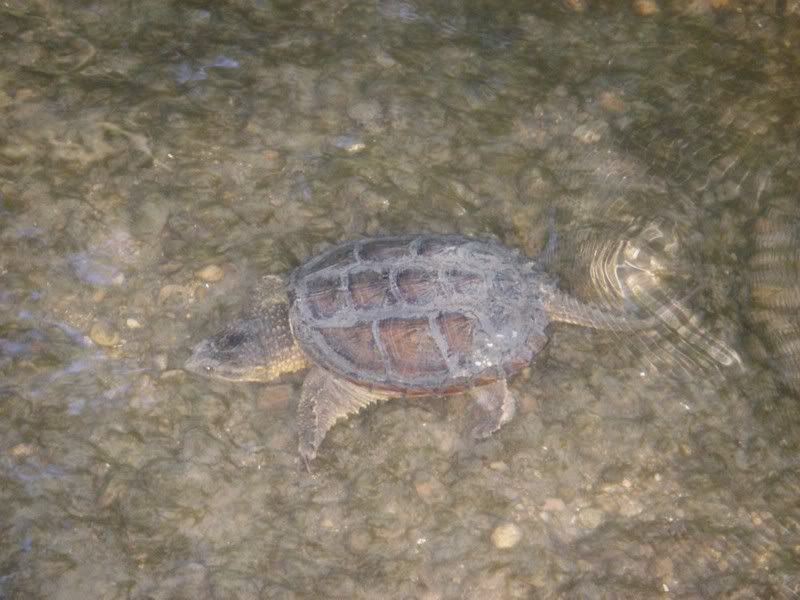
Hibernating Turtle
Low water in the creeks froze up all the eddies. No fish. Saw plenty under the thin ice. Water was far too clear. We need rain or snow.